
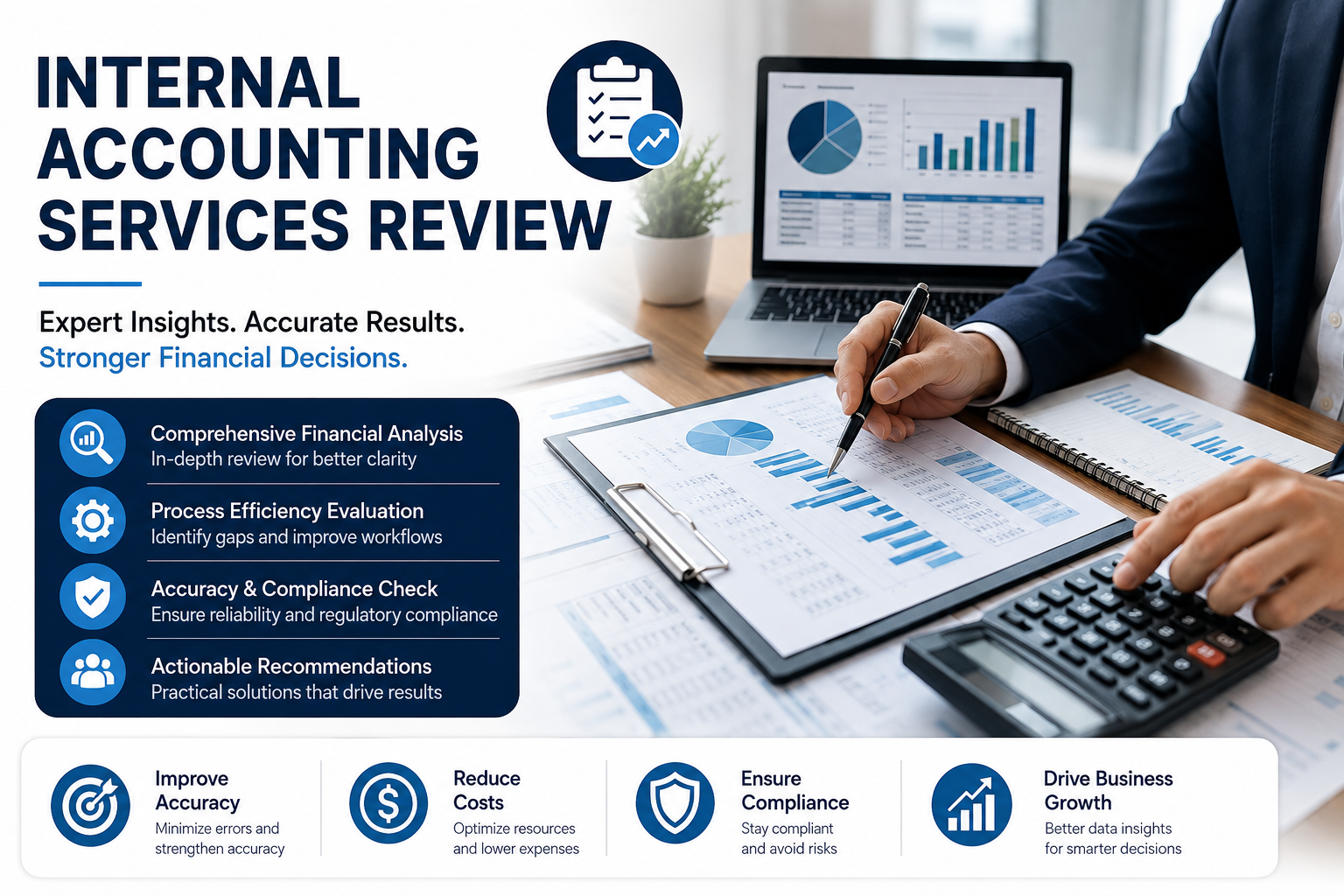
Businesses of every size rely on accurate financial records to make informed decisions, maintain compliance, and improve profitability. An Internal Accounting Services Review helps organizations evaluate their accounting processes, identify weaknesses, and implement improvements that increase financial accuracy and operational efficiency. Whether you operate a small business, a growing enterprise, or a large corporation, conducting an Internal Accounting Services Review regularly ensures your accounting system remains reliable, transparent, and aligned with your business goals.
In today's competitive environment, financial management goes beyond recording transactions. Companies need streamlined accounting workflows, accurate reporting, effective internal controls, and timely financial insights. A comprehensive Internal Accounting Services Review allows organizations to optimize their accounting operations while minimizing risks, reducing unnecessary costs, and improving decision-making capabilities.
What Is an Internal Accounting Services Review?
An Internal Accounting Services Review is a systematic assessment of an organization's accounting department, financial procedures, internal controls, reporting systems, and operational efficiency. The purpose is to determine whether accounting activities are being performed accurately, consistently, and in compliance with applicable accounting standards and regulatory requirements.
The review evaluates numerous accounting functions, including bookkeeping, payroll processing, accounts payable, accounts receivable, budgeting, financial reporting, tax preparation, bank reconciliations, cash flow management, and financial controls. Organizations often conduct an Internal Accounting Services Review annually or whenever significant business changes occur.
Unlike an external audit, which primarily focuses on financial statement accuracy for compliance purposes, an Internal Accounting Services Review emphasizes process improvement, operational efficiency, and risk reduction within the accounting department.
Why Every Business Needs an Internal Accounting Services Review
Accounting errors, outdated processes, and weak financial controls can significantly impact a company's profitability and reputation. Performing a regular Internal Accounting Services Review helps businesses detect issues before they become major financial problems.
A thorough review provides management with valuable insights into the effectiveness of existing accounting procedures. It identifies opportunities to automate repetitive tasks, eliminate duplicate work, strengthen financial controls, and improve reporting accuracy.
Organizations that perform an Internal Accounting Services Review also gain greater confidence in their financial statements, making it easier to attract investors, secure financing, and support strategic business planning.
Major Objectives of an Internal Accounting Services Review
The primary objective of an Internal Accounting Services Review is to ensure accounting operations support business growth while maintaining financial integrity. A successful review focuses on improving both accuracy and efficiency.
Key objectives include:
- Improving financial reporting accuracy
- Strengthening internal financial controls
- Reducing accounting errors
- Preventing fraud and financial irregularities
- Enhancing workflow efficiency
- Ensuring regulatory compliance
- Optimizing resource utilization
- Improving budgeting and forecasting
- Supporting better financial decision-making
- Increasing operational transparency
Achieving these objectives allows businesses to maintain healthier financial operations while supporting sustainable long-term growth.
Key Areas Covered During an Internal Accounting Services Review
An effective Internal Accounting Services Review evaluates multiple accounting functions to ensure every financial process operates efficiently.
The review generally includes:
- General ledger management
- Accounts payable procedures
- Accounts receivable management
- Payroll processing accuracy
- Cash management
- Expense reporting
- Financial statement preparation
- Inventory accounting
- Budget monitoring
- Tax compliance procedures
- Asset management
- Internal approval workflows
- Financial documentation
- Accounting software performance
- Data security practices
Reviewing these areas helps identify process gaps and opportunities for operational improvement.
Benefits of Conducting an Internal Accounting Services Review
Businesses experience numerous advantages after completing an Internal Accounting Services Review. Beyond improving accounting accuracy, the review creates opportunities to increase productivity and reduce unnecessary financial risks.
Some of the most significant benefits include improved financial visibility, faster reporting cycles, better compliance, reduced manual errors, stronger internal controls, improved audit readiness, enhanced budgeting accuracy, and greater confidence in business decision-making.
A well-executed Internal Accounting Services Review also helps management identify outdated accounting practices that may be slowing down financial operations. Replacing manual processes with automated accounting solutions often leads to significant time savings and cost reductions.
How Internal Accounting Services Improve Financial Accuracy
Financial accuracy forms the foundation of every successful organization. An Internal Accounting Services Review identifies weaknesses that may cause incorrect financial reporting or inconsistent accounting records.
Businesses frequently encounter errors resulting from duplicate entries, incorrect account classifications, delayed reconciliations, missing documentation, manual calculations, or inconsistent approval procedures. These problems can negatively affect tax filings, financial reporting, and management decisions.
By reviewing accounting workflows in detail, organizations can establish standardized procedures that reduce human error while improving financial consistency.
Regular account reconciliations, documented approval processes, segregation of duties, automated reporting, and continuous staff training all contribute to greater financial accuracy following an Internal Accounting Services Review.
Improving Operational Efficiency Through Internal Accounting Services Review
Efficiency is equally important as accuracy in modern accounting departments. An Internal Accounting Services Review examines how financial tasks are performed and identifies unnecessary delays or duplicated efforts.
Many accounting departments still rely on manual spreadsheets, paper documentation, and repetitive data entry. These outdated methods consume valuable employee time while increasing the likelihood of costly mistakes.
Through a comprehensive Internal Accounting Services Review, businesses can streamline invoice processing, automate bank reconciliations, improve payroll workflows, simplify month-end closing procedures, and integrate accounting software with other business applications.
Improved efficiency enables accounting professionals to focus on strategic financial planning rather than spending excessive time on administrative tasks.
Common Problems Identified During an Internal Accounting Services Review
Every organization has unique accounting challenges. However, certain issues frequently appear during an Internal Accounting Services Review.
- Inadequate documentation
- Weak segregation of duties
- Late financial reporting
- Incomplete account reconciliations
- Duplicate vendor payments
- Inaccurate payroll calculations
- Poor expense management
- Weak approval controls
- Outdated accounting software
- Insufficient employee training
- Inconsistent financial policies
- Limited management reporting
Addressing these issues promptly helps organizations reduce financial risk while improving overall accounting performance.
The Role of Technology in Internal Accounting Services Review
Modern accounting technology has transformed financial management. An Internal Accounting Services Review evaluates whether businesses are utilizing available technology effectively.
Cloud accounting software, automated reconciliations, artificial intelligence, financial dashboards, digital document management, workflow automation, and real-time reporting have significantly improved accounting efficiency. Organizations that leverage these technologies often experience faster financial close processes, greater reporting accuracy, and improved collaboration across departments.
Technology also enhances data security by providing role-based access controls, automated backups, audit trails, and encrypted financial records. Incorporating these tools into an Internal Accounting Services Review helps businesses build a more resilient and future-ready accounting function.
Best Practices for a Successful Internal Accounting Services Review
A successful Internal Accounting Services Review requires a structured approach and continuous monitoring rather than a one-time evaluation. Organizations should establish clear objectives, assign responsibilities, and document every accounting process before beginning the review.
Some of the best practices include maintaining standardized accounting policies, conducting regular internal reviews, reconciling accounts on time, implementing segregation of duties, automating repetitive accounting tasks, providing ongoing employee training, and using reliable accounting software. Businesses should also create key performance indicators (KPIs) to measure accounting efficiency and financial accuracy over time.
Regular communication between accounting staff and management further enhances the effectiveness of an Internal Accounting Services Review, ensuring that identified issues are resolved promptly and improvements are implemented successfully.
How Frequently Should You Perform an Internal Accounting Services Review?
The frequency of an Internal Accounting Services Review depends on the size, complexity, and regulatory requirements of the business. While many organizations conduct a comprehensive review annually, businesses experiencing rapid growth or handling large transaction volumes may benefit from quarterly or semi-annual reviews.
Additional reviews may also be necessary after implementing new accounting software, restructuring financial departments, expanding operations, acquiring another business, or experiencing significant changes in financial regulations.
Regular reviews help businesses identify emerging risks early, maintain financial compliance, and continuously improve operational efficiency.
Choosing the Right Team for an Internal Accounting Services Review
Selecting qualified professionals is essential for obtaining meaningful results from an Internal Accounting Services Review. Depending on the organization's size, the review may be conducted by an internal accounting team, internal auditors, finance managers, or independent accounting consultants.
The review team should possess expertise in financial reporting, internal controls, accounting standards, tax regulations, risk management, and accounting technology. Their objective should be to provide practical recommendations that strengthen accounting operations rather than merely identifying deficiencies.
A collaborative approach involving department managers and executive leadership helps ensure that recommended improvements align with broader business objectives.
Common Mistakes Businesses Should Avoid
Although many organizations recognize the value of an Internal Accounting Services Review, several common mistakes reduce its effectiveness.
- Treating the review as a compliance exercise only.
- Ignoring recommendations after the review is completed.
- Failing to update accounting policies regularly.
- Overlooking employee training needs.
- Depending heavily on manual accounting processes.
- Performing reviews too infrequently.
- Not documenting accounting procedures.
- Weak monitoring of internal controls.
- Insufficient management involvement.
- Delaying corrective actions.
Avoiding these mistakes allows businesses to maximize the long-term benefits of an Internal Accounting Services Review while strengthening overall financial governance.
Frequently Asked Questions (FAQs)
1. What is an Internal Accounting Services Review?
An Internal Accounting Services Review is a detailed evaluation of a company's accounting processes, financial controls, reporting systems, and operational procedures to improve accuracy, efficiency, and compliance.
2. Why is an Internal Accounting Services Review important?
It helps identify accounting errors, strengthen internal controls, improve financial reporting, reduce operational risks, and support better business decision-making.
3. How often should an Internal Accounting Services Review be conducted?
Most organizations perform a comprehensive review annually, while rapidly growing businesses or companies with complex financial operations may benefit from quarterly or semi-annual reviews.
4. What areas are evaluated during an Internal Accounting Services Review?
The review typically covers bookkeeping, payroll, accounts payable, accounts receivable, budgeting, financial reporting, internal controls, tax compliance, cash management, inventory accounting, and accounting software.
5. How does an Internal Accounting Services Review improve financial accuracy?
It identifies process weaknesses, strengthens reconciliation procedures, standardizes accounting practices, reduces manual errors, and enhances financial reporting consistency.
6. Can small businesses benefit from an Internal Accounting Services Review?
Yes. Small businesses can improve cash flow management, reduce accounting mistakes, strengthen financial controls, and prepare for future growth through regular reviews.
7. What technologies support an Internal Accounting Services Review?
Cloud accounting software, automated reconciliation tools, workflow automation, digital document management systems, financial dashboards, and AI-powered reporting solutions all contribute to a more effective review process.
8. Who should perform an Internal Accounting Services Review?
The review may be conducted by internal accounting professionals, finance managers, internal auditors, or experienced external accounting consultants with expertise in financial management and internal controls.
9. What are the long-term benefits of an Internal Accounting Services Review?
Long-term benefits include improved financial transparency, enhanced operational efficiency, stronger compliance, reduced fraud risk, better budgeting, more reliable reporting, and increased confidence among stakeholders.
10. Does an Internal Accounting Services Review replace an external audit?
No. An Internal Accounting Services Review focuses on improving internal accounting processes and operational efficiency, whereas an external audit provides an independent opinion on the accuracy of financial statements.
Conclusion
An Internal Accounting Services Review is a valuable investment for any organization seeking to improve financial accuracy, operational efficiency, and long-term business performance. By evaluating accounting processes, strengthening internal controls, and identifying opportunities for automation and process improvement, businesses can reduce errors, minimize financial risks, and make more informed strategic decisions.
Regular Internal Accounting Services Review initiatives also help organizations remain compliant with accounting standards, improve transparency, enhance reporting quality, and optimize resource utilization. As businesses continue to evolve in an increasingly competitive environment, maintaining efficient accounting operations becomes essential for sustainable growth.
Whether you operate a startup, a mid-sized company, or a large enterprise, implementing a comprehensive Internal Accounting Services Review on a regular basis ensures that your financial systems remain accurate, reliable, and prepared to support future success. Investing in continuous improvement today creates a stronger financial foundation for tomorrow.