
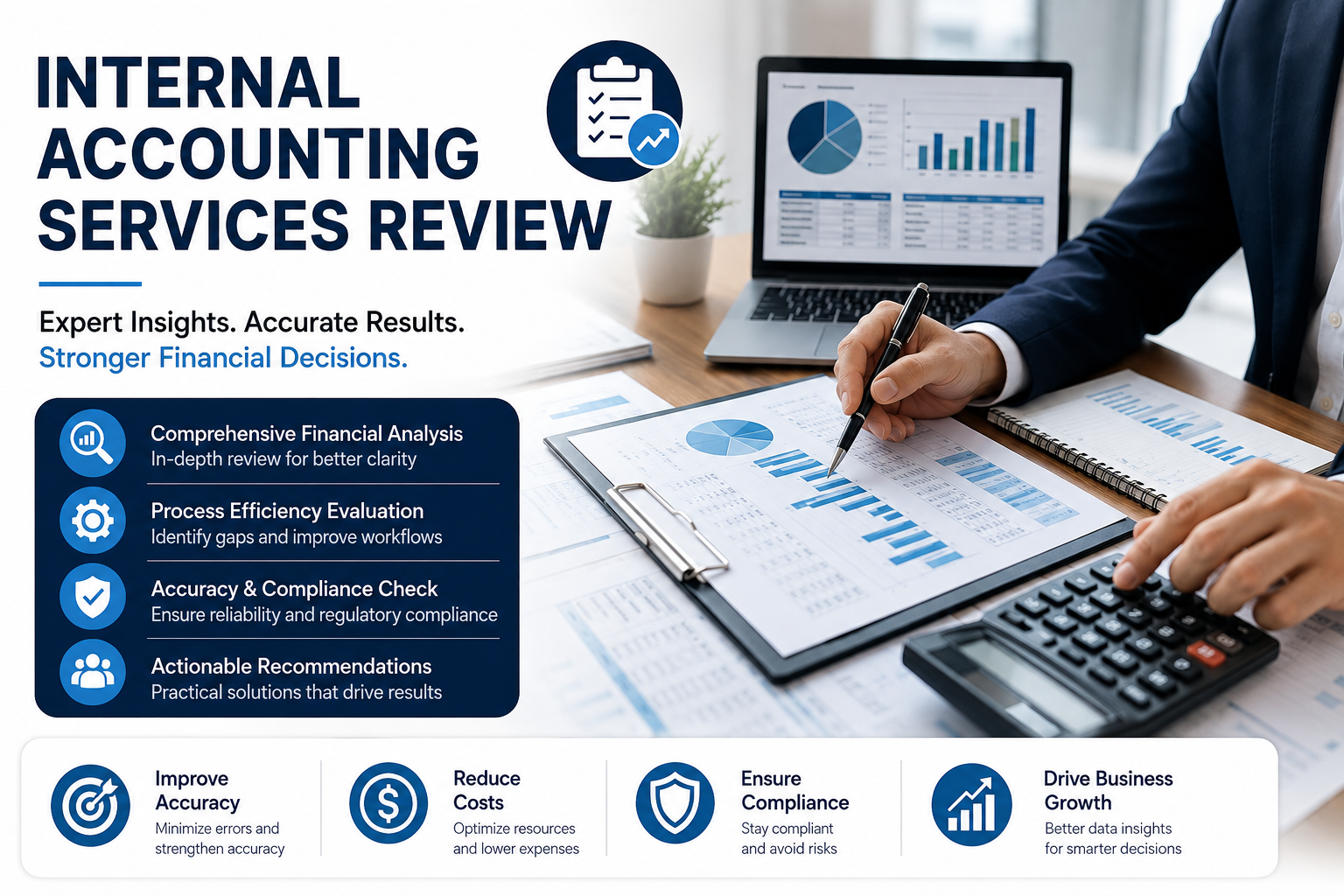
Internal accounting plays an important role in helping businesses maintain accurate financial records, monitor expenses, manage cash flow, and make informed decisions. As companies grow, managing accounting activities internally can become more complex. This is why many organizations explore professional accounting solutions and carefully examine Internal Accounting Services Reviews before choosing a service provider or improving their existing accounting processes.
Internal Accounting Services Reviews provide valuable insights into the quality, reliability, efficiency, and overall performance of accounting services. Whether a business is a startup, small company, growing organization, or established enterprise, reviewing internal accounting services can help identify strengths, weaknesses, and opportunities for improvement.
What Are Internal Accounting Services?
Internal accounting services refer to accounting functions performed within or specifically for a business to support financial management and operational decision-making. These services may include bookkeeping, accounts payable, accounts receivable, payroll accounting, bank reconciliation, financial reporting, budgeting, expense monitoring, and internal financial controls.
When businesses evaluate Internal Accounting Services Reviews, they can better understand how accounting processes affect financial accuracy and business performance. A well-managed internal accounting function gives management access to timely financial information and helps reduce avoidable errors.
Internal accounting is not limited to recording transactions. It can also support financial planning, compliance, performance analysis, and strategic decision-making. For this reason, businesses should regularly evaluate whether their accounting processes are meeting current operational requirements.
Why Internal Accounting Services Reviews Matter
Internal Accounting Services Reviews are important because accounting information directly influences many business decisions. Inaccurate or delayed financial information can make it difficult for management to understand profitability, expenses, liabilities, and available cash.
A structured review can help businesses determine whether accounting procedures are accurate, efficient, secure, and properly documented. It can also identify duplicated processes, unnecessary expenses, outdated systems, and weaknesses in financial controls.
Regular Internal Accounting Services Reviews can provide management with a clearer understanding of how well the accounting department is functioning. Businesses can then make appropriate changes to improve financial reporting and operational efficiency.
Key Areas Covered by Internal Accounting Services Reviews
A comprehensive accounting review should examine several areas rather than focusing only on bookkeeping. The following areas are commonly evaluated during Internal Accounting Services Reviews.
Bookkeeping Accuracy
Accurate bookkeeping is the foundation of reliable financial management. Reviews should examine whether transactions are recorded correctly, accounts are properly categorized, and financial records are updated consistently.
Errors in bookkeeping can affect financial statements, tax calculations, cash-flow analysis, and management reports. Businesses should therefore include bookkeeping accuracy as an important part of their Internal Accounting Services Reviews.
Accounts Payable Management
Accounts payable management involves tracking bills, supplier invoices, payment schedules, and outstanding obligations. An effective process helps businesses pay suppliers on time while maintaining adequate cash reserves.
During Internal Accounting Services Reviews, companies should evaluate invoice approval procedures, payment authorization, duplicate invoice controls, vendor records, and payment documentation.
Accounts Receivable Management
Accounts receivable directly affects business cash flow. Companies need efficient processes for invoicing customers, tracking outstanding balances, following up on overdue payments, and recording collections.
A review of accounts receivable can reveal whether customers are being invoiced promptly and whether overdue accounts are being monitored effectively. Strong receivables management can improve cash availability and reduce collection problems.
Bank Reconciliation
Bank reconciliation helps businesses compare internal accounting records with bank statements. Regular reconciliation can identify missing transactions, duplicate entries, incorrect amounts, bank charges, and unauthorized transactions.
As part of Internal Accounting Services Reviews, businesses should verify whether bank accounts are reconciled regularly and whether differences are investigated and resolved promptly.
Payroll Accounting
Payroll is another important accounting area. Businesses must ensure that employee wages, deductions, benefits, taxes, and payroll-related liabilities are recorded correctly.
Reviewing payroll procedures can help identify calculation errors, incorrect employee information, missed deductions, and weaknesses in payroll authorization. Effective payroll accounting contributes to employee satisfaction while supporting accurate financial reporting.
Financial Reporting and Analysis
Financial reports provide management with information about business performance. Common reports include income statements, balance sheets, cash-flow statements, accounts receivable reports, accounts payable reports, and budget comparisons.
Internal Accounting Services Reviews should determine whether financial reports are accurate, timely, understandable, and useful for decision-making. Reports that are delivered too late may have limited value because management needs current information when making important business decisions.
Internal Financial Controls
Internal controls are procedures designed to protect business assets and reduce the risk of errors or fraud. Examples include authorization procedures, segregation of duties, approval limits, password controls, reconciliation processes, and regular financial reviews.
Strong internal controls should be an important consideration when conducting Internal Accounting Services Reviews. Businesses should determine whether financial responsibilities are appropriately divided and whether sensitive accounting information is adequately protected.
Benefits of Conducting Internal Accounting Services Reviews
Regular Internal Accounting Services Reviews can provide several benefits. The first is improved financial accuracy. By identifying accounting errors and process weaknesses, businesses can improve the reliability of their financial records.
Reviews can also improve operational efficiency. Businesses may discover that certain accounting tasks can be automated, reorganized, or simplified. This can reduce unnecessary administrative work and allow accounting professionals to focus on higher-value activities.
Another benefit is better decision-making. When management has access to accurate and timely financial information, it becomes easier to evaluate profitability, control expenses, manage cash flow, and plan future investments.
Reviews can also strengthen financial controls. Identifying weaknesses early gives businesses an opportunity to implement corrective measures before those weaknesses result in significant financial problems.
How to Evaluate Internal Accounting Services Reviews
Businesses should use consistent criteria when evaluating Internal Accounting Services Reviews. Looking at one factor alone may not provide an accurate picture of accounting performance.
Accuracy should be one of the first evaluation criteria. Businesses should determine whether transactions, reconciliations, invoices, payroll records, and financial reports are consistently accurate.
Timeliness is another important factor. Accounting information should be available when management needs it. Delayed reports can make it difficult to respond to cash-flow problems or changing business conditions.
Businesses should also evaluate communication. Accounting teams should be able to explain financial information clearly and communicate important issues promptly.
Technology should also be considered. Modern accounting systems can automate repetitive tasks, improve reporting, reduce manual data entry, and support better financial visibility.
Common Problems Identified Through Internal Accounting Services Reviews
Many businesses discover similar issues when reviewing their accounting processes. These may include outdated bookkeeping procedures, incomplete documentation, delayed reconciliations, duplicate data entry, poor expense categorization, and inconsistent reporting.
Some organizations may also have insufficient internal controls. For example, one employee may have excessive control over multiple financial activities. This can increase the risk of errors or unauthorized transactions.
Another common issue is the lack of standardized procedures. When accounting responsibilities depend heavily on individual employees, processes may become inconsistent when employees leave or responsibilities change.
Internal Accounting Services Reviews can help identify these problems and provide a foundation for improving accounting operations.
Internal Accounting Services and Business Growth
Accounting requirements often change as a company grows. A small business may initially manage accounting with basic bookkeeping tools, while a growing organization may require more advanced reporting, payroll management, budgeting, financial analysis, and internal controls.
Regular Internal Accounting Services Reviews help businesses determine whether their accounting infrastructure is capable of supporting future growth. Companies can identify technology limitations, staffing requirements, and process improvements before they become major obstacles.
Effective accounting also helps business owners understand which products or services generate the greatest returns. This information can support decisions involving pricing, expansion, hiring, investments, and cost management.
Technology in Internal Accounting Services
Accounting technology has changed the way businesses manage financial information. Cloud accounting platforms, automated reconciliation tools, digital invoicing systems, payroll software, expense management solutions, and reporting dashboards can improve accounting efficiency.
When conducting Internal Accounting Services Reviews, businesses should assess whether their accounting technology is being used effectively. The objective should not simply be to adopt more technology but to select systems that solve specific operational problems.
Businesses should also consider data security, user permissions, backups, integration capabilities, reporting features, and scalability when evaluating accounting technology.
Best Practices for Improving Internal Accounting Services
Businesses can improve accounting operations by establishing standardized procedures for common financial activities. Written procedures can help employees understand how transactions should be recorded, reviewed, approved, and documented.
Regular reconciliations should also be performed. Bank accounts, credit cards, receivables, payables, and other important accounts should be reviewed according to an appropriate schedule.
Management should establish clear approval procedures for expenses and payments. Separating financial responsibilities among employees can also strengthen internal controls.
Businesses should maintain organized financial documentation and regularly review accounting reports. These practices can make future Internal Accounting Services Reviews more efficient and productive.
How Often Should Businesses Conduct Internal Accounting Services Reviews?
The appropriate frequency depends on the size and complexity of the organization. Small businesses may conduct a detailed review annually while monitoring key accounting activities monthly or quarterly.
Larger organizations with complex transactions may benefit from more frequent reviews. Businesses experiencing rapid growth, restructuring, technology changes, or significant financial changes should also consider conducting additional reviews.
The important objective is consistency. Internal Accounting Services Reviews should become part of an ongoing financial management strategy rather than being performed only when problems occur.
What to Look for in Internal Accounting Services Reviews
When reading or comparing Internal Accounting Services Reviews, businesses should look beyond general positive or negative comments. Relevant reviews should provide useful information about accounting accuracy, responsiveness, reporting quality, communication, technology, problem resolution, and overall service consistency.
Businesses should also consider whether the reviewed service provider has experience with organizations of a similar size and industry. Accounting requirements can vary significantly depending on the type of business, transaction volume, regulatory environment, and reporting needs.
A balanced evaluation should consider both strengths and weaknesses. The goal of reviewing accounting services is to determine whether they provide measurable value and meet the company's specific financial requirements.
Questions to Ask Before Choosing Accounting Services
Before selecting an accounting service, businesses should ask several practical questions. What accounting functions are included? How frequently are financial reports delivered? How are errors handled? What accounting software is supported? How is sensitive financial information protected? Who reviews the accounts? How are communication and support handled?
Answers to these questions can help businesses make better decisions and compare providers more effectively. Internal Accounting Services Reviews can supplement this process by providing additional perspectives on service quality and reliability.
FAQs About Internal Accounting Services Reviews
What are Internal Accounting Services Reviews?
Internal Accounting Services Reviews are structured evaluations of a company's accounting processes, financial controls, reporting practices, bookkeeping accuracy, and overall accounting performance. They help businesses identify weaknesses and opportunities for improvement.
Why are Internal Accounting Services Reviews important?
They help businesses identify accounting errors, improve financial reporting, strengthen internal controls, manage expenses, and make better financial decisions. Regular reviews can also reveal inefficient processes that may increase operating costs.
What areas should an accounting review cover?
A comprehensive review can cover bookkeeping, accounts payable, accounts receivable, payroll, bank reconciliation, financial reporting, budgeting, expense management, internal controls, accounting technology, and financial documentation.
How often should Internal Accounting Services Reviews be performed?
The appropriate frequency depends on business size and complexity. Many businesses benefit from annual detailed reviews combined with monthly or quarterly monitoring of important accounting activities.
Can Internal Accounting Services Reviews improve business performance?
Yes. Reviews can identify inefficient accounting processes, improve financial reporting, strengthen controls, reduce errors, and provide management with more reliable information for business planning and decision-making.
What should businesses consider when reading accounting service reviews?
Businesses should consider comments about accuracy, responsiveness, reporting quality, communication, technology, reliability, support, and problem resolution. Reviews should be considered alongside the company's specific accounting requirements and service expectations.
Are internal accounting services useful for small businesses?
Yes. Small businesses can benefit significantly from organized accounting processes because accurate financial information helps owners monitor cash flow, expenses, profitability, taxes, and business growth.
How can businesses improve their internal accounting processes?
Businesses can improve accounting by standardizing procedures, performing regular reconciliations, implementing appropriate approval controls, maintaining accurate documentation, using suitable accounting technology, and conducting regular Internal Accounting Services Reviews.
Conclusion: Making Better Decisions Through Internal Accounting Services Reviews
Internal Accounting Services Reviews can be a valuable resource for businesses seeking to improve financial accuracy, efficiency, reporting, and internal controls. A well-designed accounting review looks beyond basic bookkeeping and examines the complete financial workflow, including accounts payable, accounts receivable, payroll, reconciliations, reporting, technology, and internal controls.
Businesses should conduct reviews regularly and use objective criteria to evaluate accounting performance. By identifying weaknesses early, organizations can improve processes, reduce unnecessary costs, strengthen financial controls, and gain better visibility into business performance.
Ultimately, the purpose of Internal Accounting Services Reviews is not simply to determine whether accounting activities are being completed. The larger goal is to determine whether the accounting function is providing accurate, timely, secure, and useful financial information that supports sustainable business growth.